 Image 1 of 1
STRENGTH RESEARCH STACK
An advanced multi-peptide research combination designed for investigators exploring pathways associated with metabolic signaling, body composition, tissue repair, recovery, and growth-hormone activity.
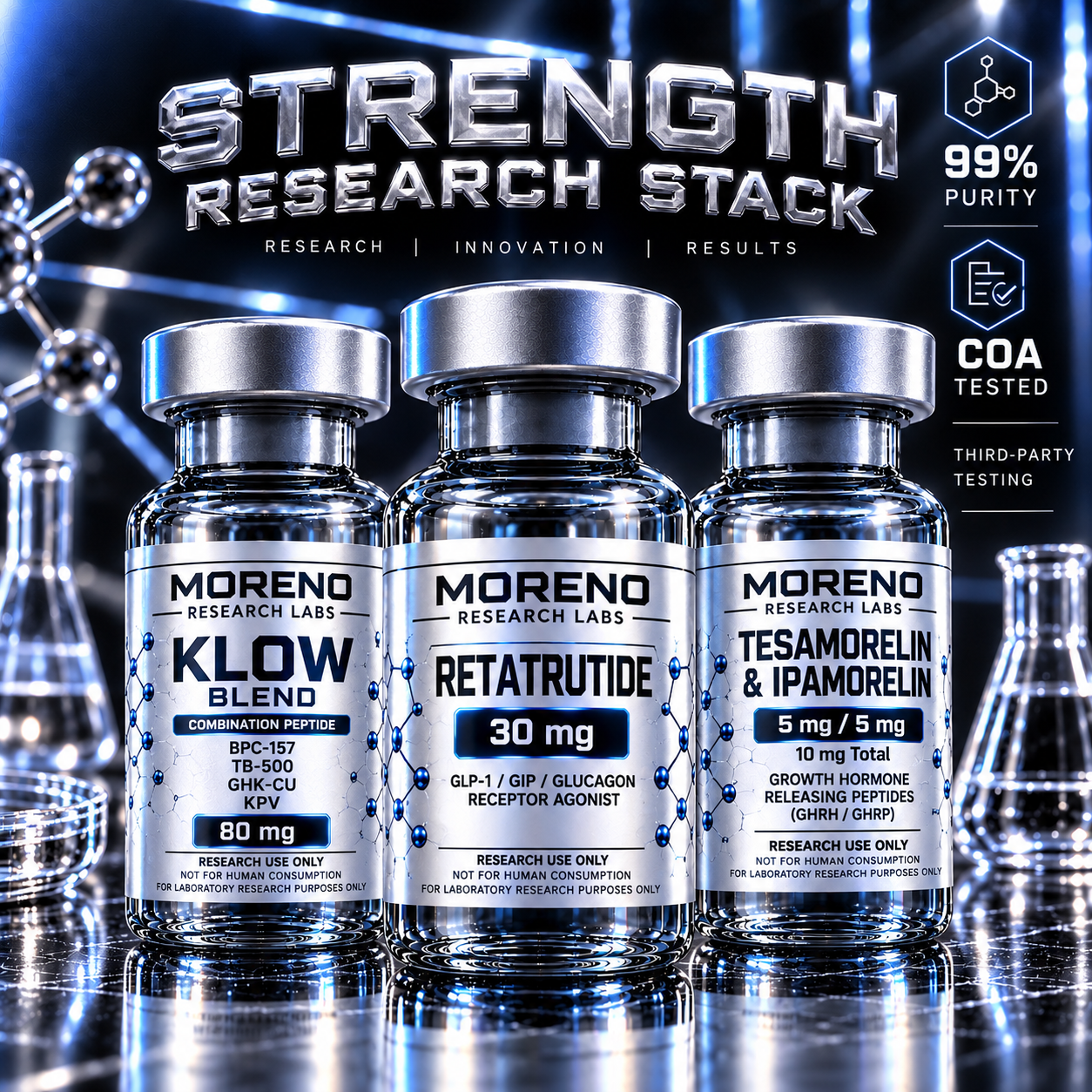
The Strength Research Stack combines Retatrutide, KLOW, and a Tesamorelin + Ipamorelin research blend, bringing together several distinct peptide mechanisms within one comprehensive research protocol.
RETATRUTIDE
Retatrutide is an investigational triple agonist that activates the GLP-1, GIP, and glucagon receptors. Research has focused on its effects on metabolic signaling, energy balance, glucose regulation, and body-weight-related pathways.
KLOW
KLOW is a four-peptide research formulation containing GHK-Cu, BPC-157, TB-500, and KPV.
GHK-Cu — a copper-binding peptide investigated for extracellular-matrix remodeling, collagen-related pathways, tissue regeneration, and cellular signaling.
BPC-157 — a synthetic peptide extensively investigated in preclinical models involving tissue repair, vascular signaling, and gastrointestinal and connective-tissue biology.
TB-500 — a research peptide related to thymosin-beta-4 biology, investigated for cellular migration, cytoskeletal activity, wound repair, and tissue-recovery pathways.
KPV — a short peptide sequence derived from α-MSH that has been investigated for its role in inflammatory signaling, particularly pathways involving NF-κB.
Together, these components provide multiple areas of research interest involving inflammation, extracellular-matrix activity, vascular signaling, and tissue-repair pathways. Importantly, research on KLOW’s individual components should not be interpreted as evidence that the combined formulation produces the same effects.
TESAMORELIN + IPAMORELIN
This combination brings together two peptides studied in relation to growth-hormone signaling.
Tesamorelin is a growth-hormone-releasing hormone (GHRH) analog investigated for its ability to stimulate the pituitary’s release of growth hormone and its effects on IGF-1 signaling and body-composition pathways.
Ipamorelin is a growth-hormone secretagogue investigated for stimulating growth-hormone release through the ghrelin/GHS receptor pathway.
The combination is of research interest because the two compounds interact with different points of the growth-hormone signaling pathway.
RESEARCH FOCUS
The Strength Research Stack brings together research areas involving:
Metabolic signaling • Energy balance • Body composition • Growth-hormone pathways • Cellular signaling • Tissue-repair pathways • Extracellular-matrix activity
Research Use Only — Not for Human or Veterinary Use.
STRENGTH RESEARCH STACK
An advanced multi-peptide research combination designed for investigators exploring pathways associated with metabolic signaling, body composition, tissue repair, recovery, and growth-hormone activity.
The Strength Research Stack combines Retatrutide, KLOW, and a Tesamorelin + Ipamorelin research blend, bringing together several distinct peptide mechanisms within one comprehensive research protocol.
RETATRUTIDE
Retatrutide is an investigational triple agonist that activates the GLP-1, GIP, and glucagon receptors. Research has focused on its effects on metabolic signaling, energy balance, glucose regulation, and body-weight-related pathways.
KLOW
KLOW is a four-peptide research formulation containing GHK-Cu, BPC-157, TB-500, and KPV.
GHK-Cu — a copper-binding peptide investigated for extracellular-matrix remodeling, collagen-related pathways, tissue regeneration, and cellular signaling.
BPC-157 — a synthetic peptide extensively investigated in preclinical models involving tissue repair, vascular signaling, and gastrointestinal and connective-tissue biology.
TB-500 — a research peptide related to thymosin-beta-4 biology, investigated for cellular migration, cytoskeletal activity, wound repair, and tissue-recovery pathways.
KPV — a short peptide sequence derived from α-MSH that has been investigated for its role in inflammatory signaling, particularly pathways involving NF-κB.
Together, these components provide multiple areas of research interest involving inflammation, extracellular-matrix activity, vascular signaling, and tissue-repair pathways. Importantly, research on KLOW’s individual components should not be interpreted as evidence that the combined formulation produces the same effects.
TESAMORELIN + IPAMORELIN
This combination brings together two peptides studied in relation to growth-hormone signaling.
Tesamorelin is a growth-hormone-releasing hormone (GHRH) analog investigated for its ability to stimulate the pituitary’s release of growth hormone and its effects on IGF-1 signaling and body-composition pathways.
Ipamorelin is a growth-hormone secretagogue investigated for stimulating growth-hormone release through the ghrelin/GHS receptor pathway.
The combination is of research interest because the two compounds interact with different points of the growth-hormone signaling pathway.
RESEARCH FOCUS
The Strength Research Stack brings together research areas involving:
Metabolic signaling • Energy balance • Body composition • Growth-hormone pathways • Cellular signaling • Tissue-repair pathways • Extracellular-matrix activity
Research Use Only — Not for Human or Veterinary Use.